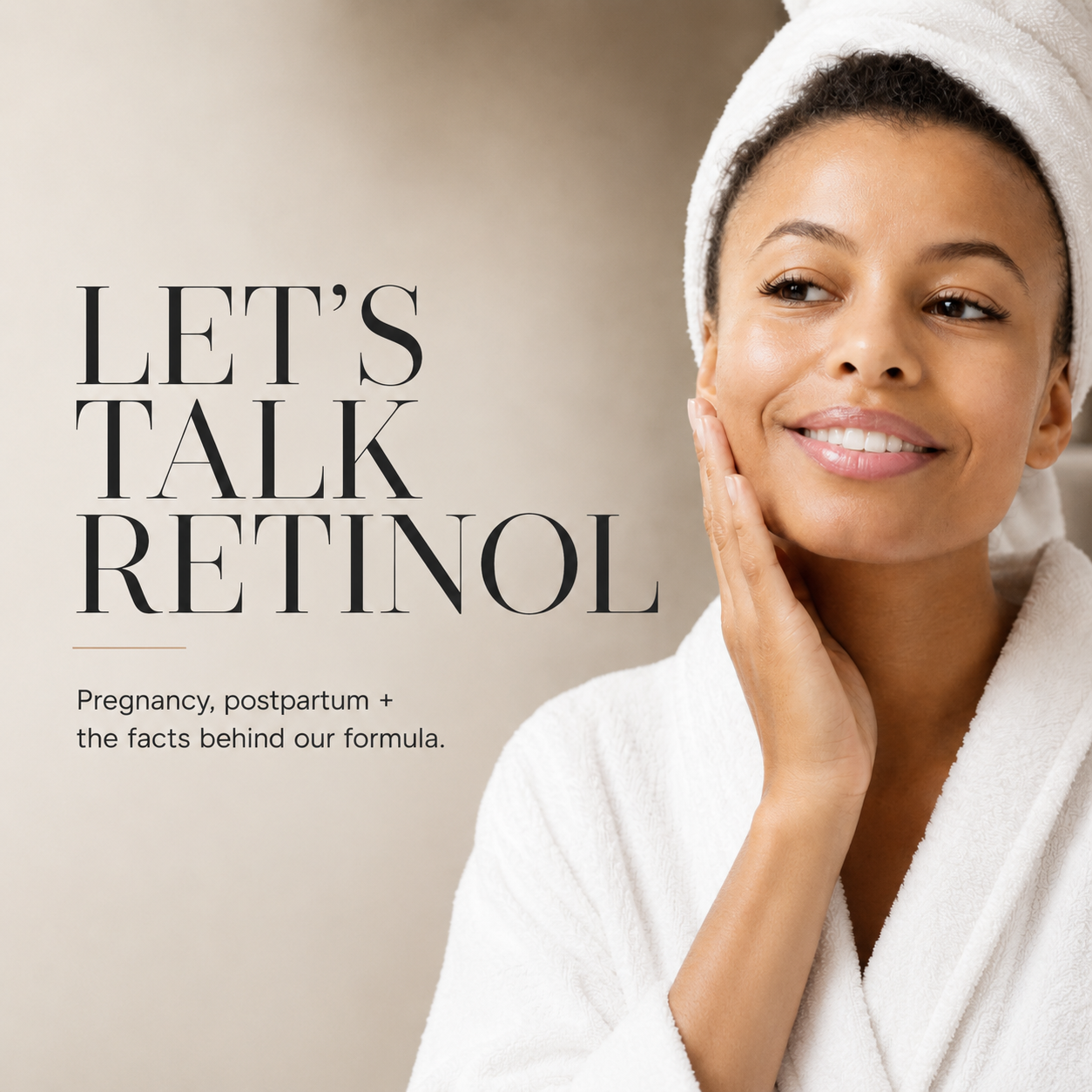
Understanding Retinol During Pregnancy
Retinol is one of the most talked-about skincare ingredients during pregnancy, and it is also one of the most misunderstood. Different forms of vitamin A, different concentrations, topical versus oral use, and the way an ingredient is formulated can all become part of the conversation.
At The Spoiled Mama, we believe the best place to start is with ingredient transparency and education. We want Mamas to know what is in their skincare, understand why an ingredient is included, review the available research, and feel comfortable sharing the complete ingredient deck with their OB/GYN or dermatologist.
Our ReHab Acne Serum and ReModel Stretch Mark Serum each contain just 0.06% encapsulated retinol. Both formulas are OB/GYN-approved and were developed with the specific skincare needs of Mamas in mind.
One piece of research that has been particularly important to our education around topical vitamin A comes directly from the FDA Office of Women's Health and the experience of a pregnant physician who contacted the FDA about a skincare product containing retinyl palmitate.
What Does the FDA Research Say About Retinyl Palmitate?
The Spoiled Mama has historically referenced research described in a report from the FDA Office of Women's Health.
The report describes the experience of Dr. Tara Rusoff, who was in the final trimester of her first pregnancy when she became concerned about a face cream she had been using that contained retinyl palmitate, a form of vitamin A.
Dr. Rusoff contacted the FDA Office of Women's Health, where her question was referred to Dr. Margaret Miller, then the Office of Women's Health Science Program Director. At the time, the FDA was sponsoring research into retinyl palmitate and pregnancy.
According to the FDA report, Dr. Miller explained that the research available to them found no evidence that the retinyl palmitate product involved was absorbed when applied to the skin.
Dr. Miller explained that the "research showed no evidence that the product retinyl palmitate was absorbed when applied to the skin."
The FDA report goes on to explain that this information reassured Dr. Rusoff, who later became the mother of a healthy baby girl.
Why We Think This Research Is Important
This FDA report is one reason we believe conversations about vitamin A in skincare deserve more context than simply seeing an ingredient name on a list.
The research described by the FDA involved retinyl palmitate. Retinyl palmitate and retinol are both vitamin A derivatives, but they are not identical ingredients. Likewise, topical skincare is different from taking a vitamin A-derived medication orally.
The ingredient itself, the concentration, the formulation, how it is delivered, how much is applied, and where it is applied can all be relevant when evaluating a skincare product.
That is why we encourage Mamas to read the complete ingredient deck rather than evaluating a product based on one ingredient name alone.
Retinol, Retinoids & Retinyl Palmitate: What's the Difference?
The terminology surrounding vitamin A can be confusing. Retinol, retinoids and retinyl palmitate are related, but the words should not be used interchangeably.
- Retinoids are the broader family of compounds related to vitamin A.
- Retinol is a form of vitamin A commonly used in over-the-counter cosmetic skincare.
- Retinyl palmitate is a vitamin A ester. It is related to retinol, but it is a different compound.
- Tretinoin is a prescription topical retinoid and is considerably different from a low-concentration cosmetic retinol formula.
- Isotretinoin is an oral prescription retinoid and is very different from topical cosmetic skincare.
Understanding these differences is important when reading pregnancy skincare articles because information about one vitamin A derivative should not automatically be applied to every other form.
So, Is Retinol Safe During Pregnancy?
There is more nuance to this question than a simple yes or no.
Research into topical vitamin A derivatives has found substantially different exposure than oral retinoids, and the FDA Office of Women's Health report above found no evidence of absorption from the specific topical retinyl palmitate product studied.
At the same time, some medical organizations currently take a precautionary approach to topical retinoids during pregnancy because pregnancy-specific data are limited.
Our approach at The Spoiled Mama is transparency. ReHab and ReModel each contain 0.06% encapsulated retinol, and the formulas are OB/GYN-approved. We provide our ingredient decks so Mamas can review exactly what they are putting on their skin and share the formula with their own OB/GYN or dermatologist whenever they want additional guidance.
Our goal is not to make the decision for you. It is to give you enough information to make an informed one.
Why We Use Encapsulated Retinol
Not all retinol formulations are created the same. Traditional retinol is sensitive to environmental factors such as light, air and heat and may be irritating for some skin types.
That is why our formulas use CelluCap™ RL encapsulated retinol. Encapsulation surrounds the retinol within a delivery system designed to protect the ingredient and release it gradually onto the skin.
- Protected formulation: Encapsulation helps protect retinol within the formula.
- Gradual delivery: The encapsulated delivery system is designed to release retinol progressively.
- Gentler approach: Controlled delivery can help provide a gentler experience than traditional retinol formulations.
- Targeted use: ReHab and ReModel are concentrated treatments designed for specific skincare concerns.
- Low concentration: Both formulas contain just 0.06% encapsulated retinol.
Encapsulation does not turn retinol into a different ingredient. Rather, it is the delivery system we selected to create a more controlled and thoughtfully formulated retinol treatment.
Why the Full Ingredient Deck Matters
When evaluating skincare during pregnancy, focusing on a single ingredient can sometimes leave out important context.
We encourage Mamas to consider the complete product formulation, including:
- The exact form of the ingredient
- The concentration used in the formula
- Whether the product is topical or oral
- How the ingredient is delivered
- How and where the product is intended to be applied
- The other ingredients included in the complete formula
This is also why we believe ingredient transparency matters. You should be able to see what is in your skincare and have enough information to discuss any ingredient with your healthcare provider if you choose.
ReHab & ReModel: 0.06% Encapsulated Retinol
Both ReHab Acne Serum and ReModel Stretch Mark Serum contain 0.06% encapsulated retinol, but they were formulated to address different skin concerns.
Get Your Glow On with ReHab
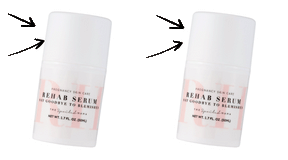
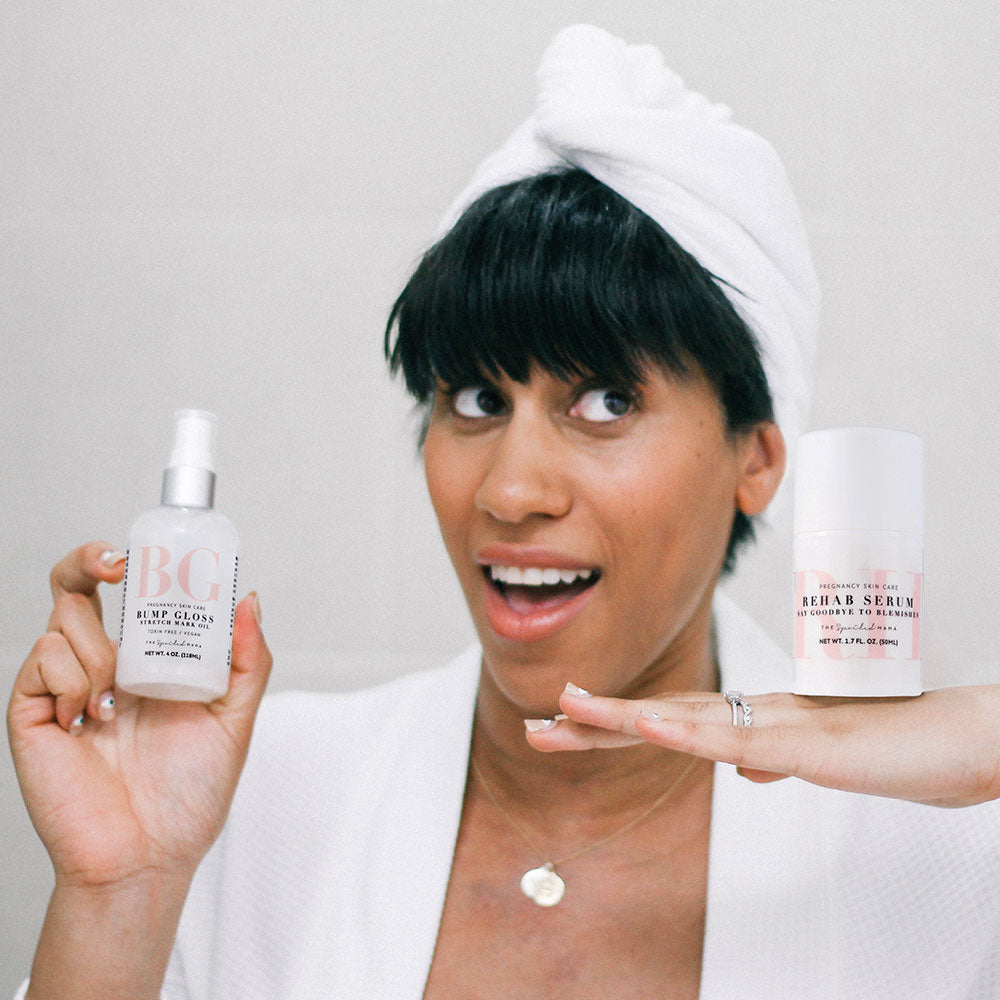
Made with 0.06% encapsulated retinol and 72% organic content, ReHab is a targeted treatment for blemish-prone and hormonally changing skin. It combines encapsulated retinol with ingredients including witch hazel and green tea while supporting hydration with hyaluronic acid.
ReHab was created specifically with Mamas in mind and is OB/GYN-approved. The complete ingredient deck is available so you can review the formula yourself or share it with your healthcare provider.
SHOP REHABBye-Bye Stretchies: ReModel Serum
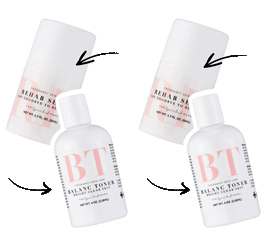
ReModel Serum contains 0.06% CelluCap™ RL encapsulated retinol along with tamanu oil and other skin-conditioning ingredients.
The formula is designed to support skin renewal and improve the visible appearance, texture and tone of new and existing stretch marks over time.
Like ReHab, ReModel was developed specifically for Mamas and is OB/GYN-approved. We encourage you to review the complete ingredient deck and share it with your own provider if you have questions about incorporating it into your routine.
SHOP REMODEL| Feature | ReHab Acne Serum | ReModel Stretch Mark Serum |
|---|---|---|
| Primary Concern | Hormonal acne, blemishes & uneven-looking texture | New & existing stretch marks |
| Encapsulated Retinol | 0.06% | 0.06% |
| Retinol Delivery | CelluCap™ RL encapsulated retinol | CelluCap™ RL encapsulated retinol |
| Key Ingredients | Hyaluronic Acid, Green Tea, Witch Hazel & Encapsulated Retinol | Tamanu Oil, Skin-Conditioning Ingredients & Encapsulated Retinol |
| Formula Review | OB/GYN-approved | OB/GYN-approved |
| Ingredient Transparency | Complete ingredient deck available for review | Complete ingredient deck available for review |
Is Retinyl Palmitate the Same as Retinol?
No. This is an important distinction.
Retinol and retinyl palmitate are both related to vitamin A, but they are different compounds. The FDA Office of Women's Health research described earlier in this article involved retinyl palmitate.
That research is relevant to the broader conversation about topical vitamin A ingredients and absorption, but it should not be described as a study of every form or concentration of topical retinol.
We believe making that distinction clearly is part of responsible ingredient education.
What Do Current Pregnancy Skincare Recommendations Say?
Pregnancy skincare recommendations can vary depending on the ingredient, formulation and healthcare provider.
Organizations including the American College of Obstetricians and Gynecologists note that the amount of topical retinoid absorbed by the body is low, while also taking a precautionary approach and generally recommending that topical retinoids be avoided during pregnancy because pregnancy-specific research is limited.
This is one reason we encourage Mamas to look at the actual ingredient deck, concentration and formulation and discuss any questions with their own OB/GYN or dermatologist rather than relying on a single ingredient name or a one-size-fits-all answer found online.
The Spoiled Mama's ReHab and ReModel formulas each contain 0.06% encapsulated retinol and are OB/GYN-approved. We make that information clear so you have the details you need to make an informed skincare decision.
Pregnancy Skincare Without Retinol
Not every Mama will choose to use a retinol-containing product during pregnancy, and that is completely okay. There are other ingredients and skincare approaches available for common concerns such as hormonal acne, dryness and uneven skin tone.
ACOG lists several topical over-the-counter acne ingredients that may be used during pregnancy, including azelaic acid, benzoyl peroxide, topical salicylic acid and glycolic acid.
Other commonly used skincare ingredients can help support hydration, the skin barrier and overall skin appearance.
- Hyaluronic acid: Helps attract and retain moisture for hydrated-looking skin.
- Vitamin C: Provides antioxidant support and can help improve the appearance of uneven tone.
- Glycolic acid: Helps gently exfoliate and improve the appearance of clogged or uneven-looking skin.
- Azelaic acid: Frequently discussed as an option for blemish-prone skin and uneven pigmentation during pregnancy.
- Daily SPF 30+: Particularly important when managing dark spots, melasma and post-blemish discoloration.
For Mamas looking for another option for blemish-prone skin, explore our BalanC Toner for Hormonal Acne.
Retinol & Pregnancy Stretch Marks
Pregnancy stretch marks develop as skin changes rapidly and collagen and elastin fibers are placed under stress. Genetics, hormones, hydration and the rate of skin stretching can all influence how someone's skin responds.
No skincare product can guarantee that stretch marks will be completely prevented or removed. During pregnancy, keeping stretching skin well moisturized can help support softness, comfort and the skin's moisture barrier with a rich daily moisturizer like our Tummy Butter.
For existing stretch marks, targeted skincare can focus on improving their visible tone, texture and overall appearance over time.
ReModel Stretch Mark Serum combines 0.06% encapsulated retinol with tamanu oil and other skin-conditioning ingredients in a concentrated treatment created specifically for stretch-prone skin.
Pregnancy Retinol FAQ
Is retinol safe to use during pregnancy?
There is nuance around topical retinol during pregnancy. Topical exposure is different from oral retinoid use, and available research has examined absorption of different vitamin A derivatives. Some medical organizations currently take a precautionary approach to topical retinoids because pregnancy-specific data are limited. The Spoiled Mama's ReHab and ReModel formulas each contain 0.06% encapsulated retinol and are OB/GYN-approved. We encourage Mamas to review the complete ingredient deck and discuss it with their own provider if they have questions.
What does the FDA say about retinyl palmitate during pregnancy?
An FDA Office of Women's Health report describes the experience of pregnant physician Dr. Tara Rusoff. According to the report, FDA-sponsored research available at the time found no evidence that the retinyl palmitate product involved was absorbed when applied to the skin. The report explains that Dr. Margaret Miller shared those findings with Dr. Rusoff.
Is retinyl palmitate the same as retinol?
No. Retinol and retinyl palmitate are both vitamin A derivatives, but they are different compounds. Research involving retinyl palmitate should therefore be identified as research involving that particular form of vitamin A rather than every type of retinol or retinoid.
What makes encapsulated retinol different?
Encapsulated retinol uses a delivery system that helps protect the retinol within the formula and release it gradually onto the skin. The Spoiled Mama uses CelluCap™ RL encapsulated retinol in ReHab and ReModel.
How much retinol is in The Spoiled Mama's ReHab and ReModel Serums?
Both ReHab Acne Serum and ReModel Stretch Mark Serum contain 0.06% encapsulated retinol.
Are ReHab and ReModel OB/GYN-approved?
Yes. Both formulas are OB/GYN-approved and were developed specifically with the skincare needs of Mamas in mind. We also provide complete ingredient information so Mamas can review the formulas themselves and share them with their individual healthcare providers.
Why does The Spoiled Mama recommend reviewing the entire ingredient deck?
A single ingredient name does not tell you everything about a skincare formula. The specific form of an ingredient, its concentration, delivery system, intended application and the rest of the formulation all provide useful context. We believe Mamas should have access to that information so they can make informed skincare choices.
What if I already used a retinol skincare product while pregnant?
Topical skincare exposure is different from taking an oral retinoid. If you have questions about something you have already used, look at the exact ingredient, concentration and product directions and share the ingredient deck with your OB/GYN or dermatologist. This allows your provider to evaluate the actual product rather than an ingredient name alone.
Can I use ReHab and ReModel postpartum?
ReHab and ReModel were formulated for Mamas through changing stages of their skincare routines, including postpartum. If you are breastfeeding and have questions about retinol or any other active ingredient, you can share the complete ingredient deck with your OB/GYN, dermatologist or other healthcare provider.
What can I use if I prefer not to use retinol during pregnancy?
There are several other options depending on your skin concern. ACOG lists azelaic acid, topical benzoyl peroxide, topical salicylic acid and glycolic acid among over-the-counter acne ingredients that may be used during pregnancy. Hydrating ingredients such as hyaluronic acid and consistent broad-spectrum sun protection can also play important roles in a pregnancy skincare routine.
Can encapsulated retinol help the appearance of stretch marks?
Retinol is used in skincare to support skin renewal and improve the appearance of texture and tone. ReModel combines 0.06% encapsulated retinol with tamanu oil and other skin-conditioning ingredients to target the visible appearance of existing stretch marks over time.
Ingredient Transparency Has Always Mattered to Us
The Spoiled Mama has focused specifically on pregnancy and postpartum skincare since 2007. Founded by a registered nurse after recognizing how difficult it was for Mamas to find skincare created specifically for pregnancy, our mission has always included both thoughtfully formulated products and ingredient education.
Our skincare is developed specifically for Mamas, made in the USA, cruelty-free and created with pregnancy-specific ingredient considerations. Our formulas are OB/GYN-approved, and we believe Mamas should always be able to see what is in the products they use.
More than 40,000 Mamas have trusted The Spoiled Mama through pregnancy, postpartum and beyond.
Transparency also means recognizing that skincare recommendations can evolve and that different healthcare providers may take different approaches to particular ingredients.
We encourage you to read ingredient decks, ask questions and share our formulations with your own OB/GYN or dermatologist whenever you want additional guidance.
We believe informed Mamas make empowered skincare decisions.
Medical Sources & Further Reading
We believe pregnancy skincare education should be supported by credible outside sources. The following resources provide additional information about topical skincare ingredients, retinoids and pregnancy:
- FDA Office of Women's Health: Protecting and Advancing Women's Health, including the Dr. Tara Rusoff retinyl palmitate discussion
- American College of Obstetricians and Gynecologists: Skin Conditions During Pregnancy
- MotherToBaby: Topical Acne Treatments
If you have questions about a specific product or ingredient, feel free to take or email our complete ingredient list to your OB/GYN or dermatologist. We want you to have the information you need to feel informed and confident about your skincare routine.


Updated August 31, 2026 | Pregnancy skincare education from The Spoiled Mama
This article is provided for educational purposes and is not a substitute for individualized medical advice. Pregnancy and breastfeeding recommendations may vary by individual and healthcare provider. If you have questions about retinol or another skincare ingredient, review the complete ingredient deck with your OB/GYN, dermatologist or other qualified healthcare provider.


Leave a comment
All comments are moderated before being published.
This site is protected by hCaptcha and the hCaptcha Privacy Policy and Terms of Service apply.